 ← BLOG | NEWS ROOM
Does Road Salt Corrode Aluminum Truck Bodies in Livonia?
Plenty of Livonia truck owners went aluminum for one reason. They were sick of watching steel fenders bubble.
Fair enough. But somewhere along the way, a lot of people decided salt can’t hurt the truck anymore, and that’s where they get burned.
Does Road Salt Corrode Aluminum Truck Bodies?
Yes, road salt corrodes aluminum. It won’t rust it, though, since rust is iron oxide and there’s no iron in an aluminum panel.
So what do you see instead? White, chalky powder and little pits in bare metal.
Or paint that lifts in thin, wormy lines, almost like something crawled under it.
Bare aluminum covers itself with a thin oxide skin the second air hits it. Salt water gets through that skin at the weak spots, and the metal underneath starts to pit.
Is it tougher than bare steel? Sure.
Salt-proof? Not even close, and a truck that goes a whole Michigan winter without a wash will show it sooner or later.
How an Exterior Car Wash Helps an Aluminum Truck Body
Salt only does damage while it’s sitting there. Get it off, and the reaction has nothing left to feed on.
Brine’s the real problem. According to AAA, liquid de-icers stay liquid longer than rock salt, which means they coat parts and seep into cracks and crevices.
And that’s what the I-96 and I-275 ramps throw at you all season. It dries on the lower doors and the bed sides, and on a gray morning you’d never notice.
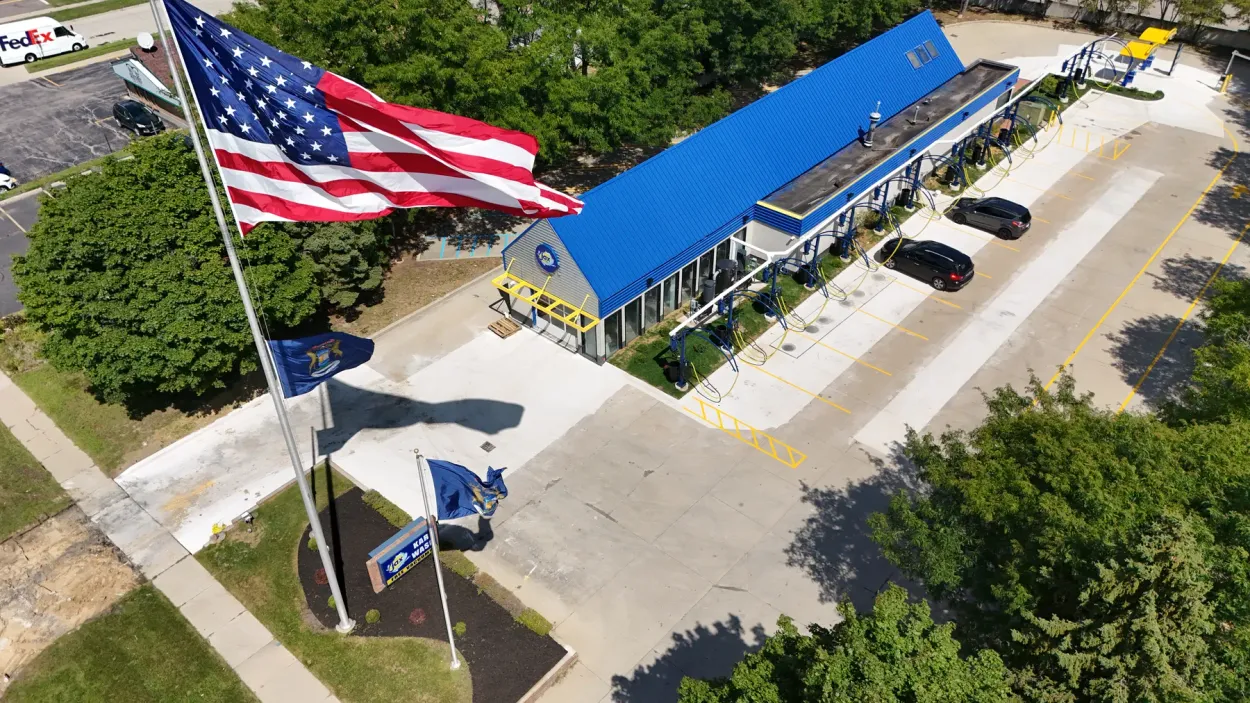
An exterior car wash at Jax Kar Wash on Middlebelt takes that film off before it gets comfortable. Every Jax exterior wash comes with an underbody wash (basically a blast of water aimed at the salt underneath) and a towel-dry finish.
No brushes, either. Jax washes with heavily lubricated soft cloth, so grit isn’t getting dragged across the finish.
The Three Ways Salt Attacks Aluminum
Here’s the quick version of how aluminum gets eaten. The Aluminum Association names three kinds of corrosion (Repairer Driven News has a good rundown), and salt water’s in on all three.
Crevice corrosion is sneaky. It sets up in tight overlaps, like aluminum on aluminum or aluminum pressed against steel or plastic, and you mostly won’t see the shallow pits it leaves.
Filiform is the one that wrecks paint. It needs a way in, like a rock chip, a scratch, or a drilled hole.
Water gets under there and spreads in thin little threads of white powder. That’s why the paint bubbles in lines instead of one big blister.
Galvanic is the slow one. Aluminum touching another metal, say a steel bracket, with salty water bridging them, and the aluminum gives up ground bit by bit.
Where Salt Sits on an Aluminum Truck in Livonia
Folded edges first, every time: door bottoms, the lip at the bottom of the tailgate, the wheel arch edges.
Then whatever you bolted on. If a step, ladder rack, or bed accessory has steel clamped right against an aluminum panel and nobody used insulating hardware, that’s a galvanic setup.
Don’t know what the installer used? A quick phone call will tell you.
People forget the bed. Toss some shoveled slush or a load of firewood back there, and it sits on the floor and the tailgate seam for days.
Front end too, because that’s where the rocks hit. Check the front edge of the hood, plus the lower doors right behind the front tires.
Stone Chips Matter More on Aluminum
Steel chips turn into orange freckles you can’t miss.
Aluminum chips? They just sit there looking like nothing.
Meanwhile water’s creeping under the paint. By the time it bubbles, it’s already spread, so dab some touch-up paint on chips when you first see them instead of giving them another winter.
A touch-up pen from the parts counter is cheap. The body work it saves you is not.
Funny thing, a clean truck helps here too. You’ll actually notice a new chip on a clean panel, where road film would’ve hidden it till spring.
One heads-up: if there’s already white powder or bubbling, washing won’t undo it. Have a body shop look while it’s still a small job.
A Salt-Season Wash Habit for Livonia Trucks
Really, the whole plan is don’t let salt sit. AAA’s version is to wash often in winter and pay extra attention to the undercarriage.
Every week or two covers most Livonia drivers, and a regular commute on salted roads is reason enough.
Just came through fresh brine on Middlebelt or the freeway? Don’t wait.
Parking counts too. If your truck spends the workday in a slushy lot off Plymouth Rd, it’s sitting in the same brine as the freeway.
Also, don’t quit the day the plows park. AAA recommends a good spring cleaning, too, to flush out what’s still hiding in the seams.
How do you actually stick with it? Hook it onto a trip you already make, like the drive back from Seven Mile or Farmington Rd, so your truck isn’t marinating in a week of brine.
Frequently Asked Questions
Will an aluminum truck body rust?
Nope, it can’t rust, because rust needs iron and there isn’t any in aluminum. It’ll still corrode if you let salt sit on it, and that looks like white powder, little pits, or paint that starts bubbling.
What does aluminum corrosion look like on a truck?
White or gray chalky gunk on bare metal, mostly. On a painted panel you’ll get bubbles running in skinny lines, and they tend to show up by a seam, a door bottom, or some old rock chip you forgot about.
Is an automatic car wash safe for an aluminum truck?
Yes, it’s fine, as long as it’s soft cloth like ours. We don’t use brushes at Jax, the cloth gets plenty of lubrication, and you get the underbody wash with any exterior wash anyway.
How often should I wash an aluminum truck in winter?
Every week or two while there’s salt on the road.
If you just drove through a fresh coat of brine, we’d go now instead of waiting it out, since liquid brine works its way into the seams.
Visit Jax Kar Wash in Livonia
Aluminum buys you time against salt, not a free pass. Keep the brine off the seams and chips, and that body’s going to hold up for a long time.
We’re at 15518 Middlebelt Rd in Livonia.
Questions about fitting your truck through the wash? Give us a call at (734) 251-3355.