
 ← BLOG | NEWS ROOM
Does Road Salt Damage Your Tires? What Jackson Drivers Should Actually Check
By the middle of a Michigan winter, your tires look rough. The sidewalls go chalky gray, the tread is packed with slush, and the pressure light blinks on during the first cold morning. So it’s fair to ask whether the salt is eating your tires.
The short answer is not really, at least not the way it goes after your undercarriage. Salt is rarely what ends a tire’s life. But it isn’t harmless either, and the weather that comes with salted roads causes a few tire problems of its own. Here’s what deserves your attention on a Jackson commute and what doesn’t.
Does Road Salt Damage Tires, or Is It Mostly Cosmetic?
Mostly cosmetic, with a couple of caveats. Tire rubber is made to sit in rain, slush, and road chemicals for years, and salt doesn’t dissolve it. What you see after a week on salted roads is residue, a dry white film on the sidewall that dulls the black rubber.
Tire shops don’t agree on how much brine does to rubber over many winters. Some blame it for cracking and slow leaks, and others call it a surface film that rinses right off. We’d call that unsettled. So treat a clean tire as cheap insurance, not a cure.
Dry rot is a different story. Cracks along the sidewall usually come from age and sun exposure, not from salt. If your tires are old enough to crack, they were headed there anyway.
What Salt Film Actually Does to Your Tires Day to Day
A dry film makes the sidewall look gray, and some de-icers stay damp longer than plain salt, so the residue can hang around between rains. It’s an appearance problem first. You’ll notice it on a black tire long before it matters to the rubber.
On the tread, the film usually wears off within a few miles of driving. Grip isn’t the worry people make it out to be. Slush and ice packed into the tread grooves is the bigger issue, and that clears with a rinse and a few minutes of rolling.
If the sidewalls bother you, plain water and a soft brush do the job. Skip anything harsh. You’re lifting a film, not scrubbing off rubber.
Cold Does More to Your Tires Than Salt Does
Here’s the part most people miss. Air pressure falls by roughly 1 psi for every 10 degrees the temperature drops. A tire that was fine on a mild fall afternoon can be several pounds low after the first hard freeze, and it doesn’t need a leak to get there.
Low pressure wears the edges of the tread faster, makes the car feel lazier in a turn, and costs you fuel. The warning light doesn’t come on until a tire is well under where it should be, so waiting for the light means driving low for a while.
Check your pressure about once a month with a gauge, and again after a big cold snap. Do it when the tires are cold, before you drive. Set each tire to the number on the sticker inside the driver’s door jamb, not the maximum pressure molded into the sidewall.
Slush, Potholes, and Damage That Gets Blamed on Salt
Salt gets blamed for plenty it didn’t do. A bulge in the sidewall, a bubble, or a clean cut is impact damage, usually from a pothole or a curb hidden under slush. Freezing and thawing open up Michigan roads all winter, and those hits add up.
If you find a bulge or a cut, don’t wait it out. Have a tire shop look at it before your next highway drive. And if one tire drops a few pounds every week while the others hold, that’s a leak, not the cold, and it needs a shop too.
While you’re down there, try the penny test. Put a penny into a tread groove with Lincoln’s head pointing down. If you can see all of his head, the tread is worn and it’s time to shop for tires.
How to Keep Salt Off Your Tires in Jackson
The easy fix is the same one that protects the rest of the car. After a week of salted roads, a pass through an automatic car wash rinses the film off the paint and glass, and the tire sidewalls get rinsed right along with them. You stay in your seat the whole time, so it fits into a stop on the way home.
Timing matters a little. Wash after the plows have come through and the roads start to dry, not in the middle of a storm, because you’ll be coated again before the next light. And don’t wait for a warm day. Salt keeps working in the cold, so a wash at freezing temperatures still beats letting it sit.
If you’re washing every week or so all winter, the Unlimited Club lets you wash as often as your plan allows. Between washes, a quick gauge check and a look at the sidewalls takes about two minutes per tire.
Frequently Asked Questions
Can road salt cause tire dry rot?
No. Dry rot comes from age, sun exposure, and years of flexing, not from salt. A salt film can make an already cracked tire look worse, though, so rinse the sidewalls and look closely at any cracks.
Should I rinse my tires in winter?
Yes. A rinse lifts the salt film at any temperature, and the sooner it goes, the less time it spends sitting on the rubber. You don’t need a warm day to do it.
Does cold weather really lower tire pressure?
It does. Pressure drops roughly 1 psi for every 10 degrees the temperature falls, so a cold snap can leave all four tires low overnight with no leak at all.
How often should I check my tire pressure in winter?
About once a month, and again after a sharp drop in temperature. Check them cold, before you drive, and fill to the number on the door jamb sticker.
Visit Jax Kar Wash in Jackson
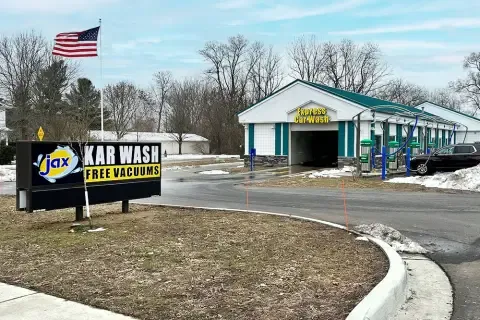
Jax Kar Wash on West Ave is at 1312 S. West Ave. in Jackson. The maximum vehicle height is 7 feet, and if you have questions about tire width or fit, the on-site team can answer them before you enter the wash.
Check current hours on the location page, or call the West Ave team at (517) 795-1028 with questions about wash options or the Unlimited Club.