
 ← BLOG | NEWS ROOM
Why Wheel Wells Trap So Much Salt After Walled Lake Winter Driving
Crouch down next to your front tire after a week of slushy driving around Walled Lake, and look at that gray crust packed up inside the wheel well. A lot of it is road salt, and it’s been riding around with you the whole time.
Wheel wells are basically a catch basin for whatever your tires throw. And the plastic liner up in there, the fender liner, is doing more work than most people realize.
Why Salt in Wheel Wells Builds Up So Fast
Salt in wheel wells builds up fast because your tires spray salty slush straight up into them every time you drive on treated roads. The liner catches it, the cold keeps it packed in place, and every trip down Decker Road adds another layer.
In a dry climate, that crust would just fall off. Here, it stays damp and salty for days, and it sits right next to steel and suspension parts the whole time.
What Fender Liners Do, and Where Salt Hides
A fender liner is the curved panel inside the wheel well, and its job is to be the barrier between that tire spray and the rest of the car. Chaney’s Collision has a good rundown on them, noting that most modern cars use a thermoplastic liner that doesn’t corrode, while older cars often had metal ones.
Here’s the catch, though. Liners aren’t sealed; they’re clipped and screwed in, and salty slush works its way into the gaps and edges where the liner meets the fender.
That’s the part you can’t see without pulling a wheel. Salt that gets behind the liner sits against the fender metal, and Chaney’s points out that some of the worst corrosion on a car happens right there in the wheel well.
Plastic vs. Felt Fender Liners in Salt Season
Not every liner handles winter the same way. Hard plastic liners shed water pretty well once they’re rinsed, so a good wash gets most of the salt off them.
A lot of newer cars use a fuzzy, felt-like liner instead (it’s quieter on the highway). SlashGear’s guide to cleaning wheel wells treats those carpet-style liners separately, because they hold onto dirt and water a lot more than smooth plastic does.
If yours is the felt kind, it’s worth washing more often in salt season. That material can stay soaked with salty water long after the roads dry up.
How an Automatic Car Wash Flushes the Wheel Wells
The trick with wheel wells is frequency, not force. Washing often keeps the salt layer thin and loose, so it rinses out instead of baking into a crust you have to chip at.
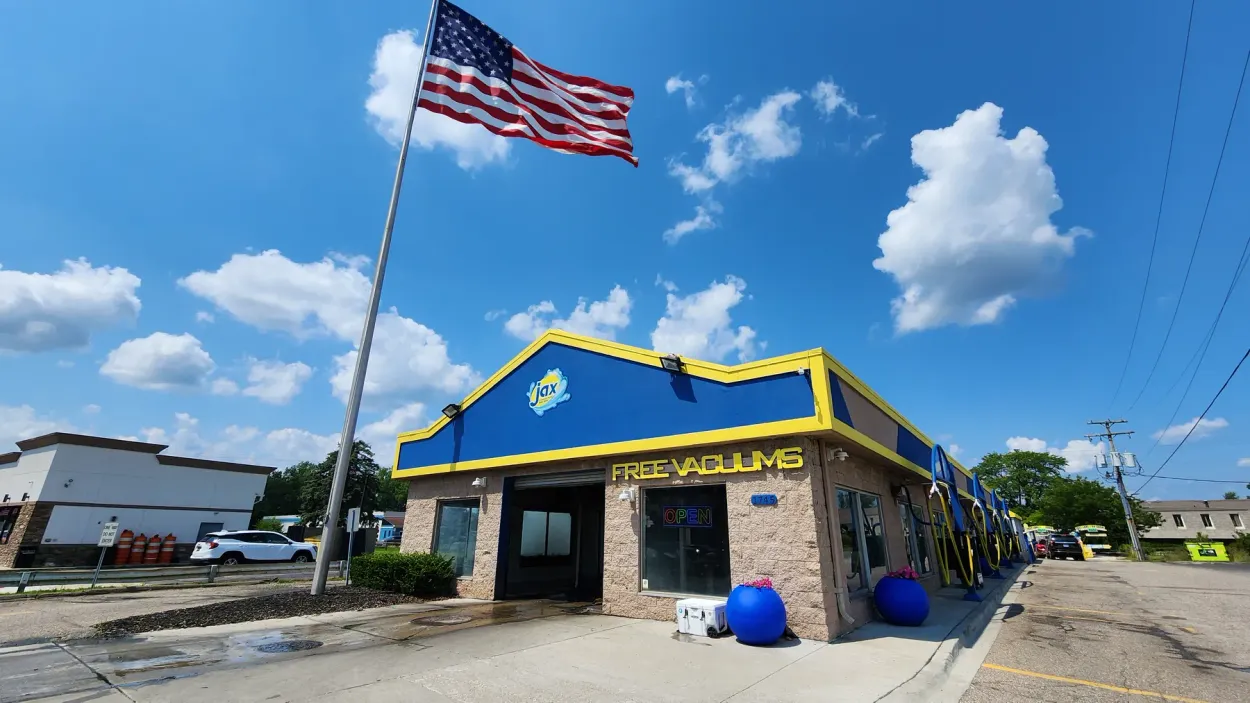
An automatic car wash at Jax Kar Wash in Walled Lake makes that easy to keep up with in the cold. Every wash on the Jax menu includes an Underbody Wash, which the menu describes as a blast of water to help rinse dirt and salt off the undercarriage.
To be honest about it, no wash pulls every chunk of packed ice out of a wheel well. What regular washing does is keep fresh salt from stacking up on top of old salt, which is how the thick buildup happens in the first place.
A driveway hose doesn’t really cut it in winter anyway. Spraying a freezing car in a freezing driveway just leaves you with icy wheel wells and a frozen hose.
A Quick Wheel Well Check You Can Do Yourself
You don’t need a lift for this one. Grab a flashlight, crank the steering wheel all the way to one side, and most of the front liner is right there in plain view.
What you’re looking for is anything that’s come loose: a popped clip, an edge hanging down, a spot where the tire has rubbed the liner thin. Any of that means salt has an easier path behind it.
Then push on the edge a little with your hand. If it pulls away from the fender without much effort, have a shop re-clip it (or swap it) before the worst of the salt shows up.
How Often to Rinse the Wheel Wells in Salt Season
Honestly, there’s no magic number. Wash after a run of salted roads, and again after it thaws and refreezes, because melting slush drags salt into spots it couldn’t get to when it was frozen solid.
Got felt liners, or an older car with metal ones? Give those a little extra attention, and the same goes if the car lives outside, since that slush never gets a real chance to dry.
Don’t Kick the Ice Out of Your Wheel Wells
Look, we get it. There’s a giant frozen lump scraping the tire every time you turn, and one good kick looks like the fix.
The problem is old plastic liners crack, and clips pop out. Then the liner flaps around, rubs on the tire, and opens up even bigger gaps for salt to sneak behind.
Let those chunks melt off on their own (a garage helps a lot), then get the car washed so all that salty runoff doesn’t just freeze back up. Waiting is a lot cheaper than buying a new liner.
Frequently Asked Questions
Does salt in wheel wells cause rust?
It can, mostly where salt gets past the liner and sits against the fender metal or suspension parts. The liner itself is usually plastic, but the steel around it isn’t.
Can I just hose out my wheel wells at home?
You can in mild weather, but in a Michigan winter it’s tough. The water freezes fast, the hose freezes too, and a quick rinse usually doesn’t get at the salt packed into the liner edges.
Should I kick the ice out of my wheel wells?
No, it’s better not to. A hard kick can crack the fender liner or knock it loose, so let the ice melt off and wash the car once it does.
Do fender liners need to be replaced?
Sometimes, yes, especially on older cars or after the liner gets cracked or torn. Chaney’s notes that liners aren’t meant to last forever and should be checked during the winter.
Visit Jax Kar Wash in Walled Lake
Keep the wheel wells rinsed, and the salt never gets the chance to cake up behind the liners. Next time the car’s crusty around the tires, stop in at Jax Kar Wash at 1745 Maple Rd in Walled Lake (or call (248) 669-2190).